
Nidus News
Follow this page for community alerts, updates, event announcements, and more.
Never miss important news from Nidus. Click here to subscribe.
Explore our past newsletters here.
Personal Planning Month – Events and Party Kits!
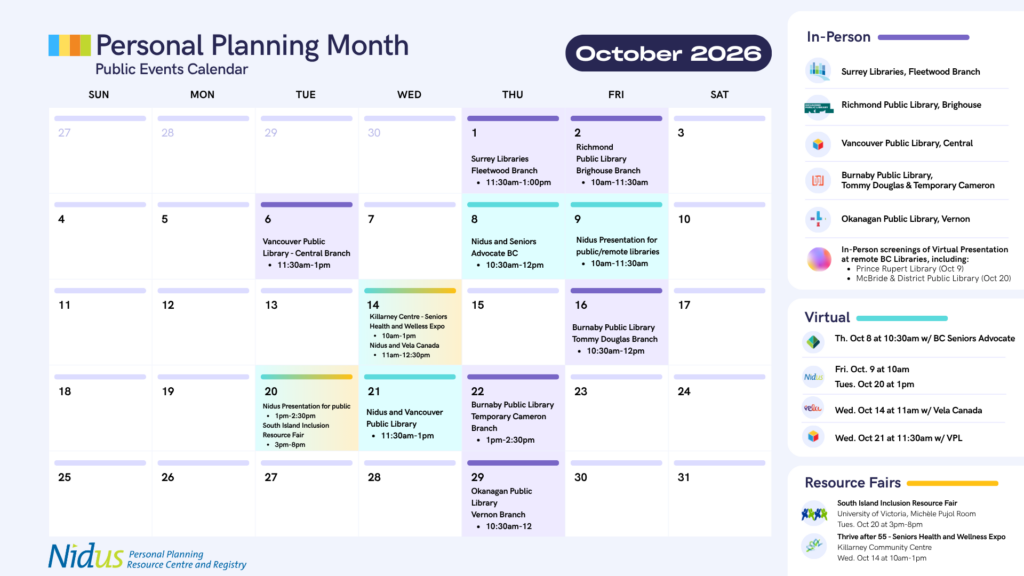
October is Personal Planning Month, a time to raise awareness and encourage British Columbians to take action on legal planning for their present and future. We have so many events taking place in October to help you get started – virtual, in-person (at libraries across BC), and in collaboration with the BC Seniors Advocate and Vela Canada. Sign up now at https://nidus.ca/events
Get Started with our Party Kits!
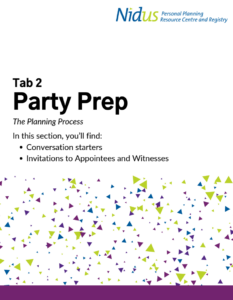 This Personal Planning Month, we are inviting everyone to party with us — Check out our new RA Party Kits at nidus.ca/party!
Our team has created comprehensive Representation Agreement kits with everything you need to plan your in-person meet-up (or ‘party’) to make your first RA.
Review a Decision Tree to choose which kit is right for your situation, which takes you to a one-stop downloadable and printable kit with everything you need.
Kits include…
- Invitations to witnesses and appointees! ✉️✉️✉️
- Conversation starters with the people being appointed! 💬💬💬
- Nidus RA Forms with fillable form fields & steps for signing! 🖊️🖊️🖊️
- and more!
Get started with your RA Party Kit at nidus.ca/party
About Nidus
Nidus Personal Planning Resource Centre and Registry (Nidus) is a BC non-profit charity that specializes in education and support around personal planning: making legal arrangements to authorize people you trust to help you with decision-making if you need help. Nidus has expertise in Representation Agreements (RAs) and other BC-only personal planning tools, providing free RA forms and kits, resources and training for professionals, policy consultation for third parties, support for the general public, and the Nidus Registry, a secure online repository for important legal documents.
BC Supreme Court rules BC’s Involuntary Treatment Regime unconstitutional – Impacts to Representation Agreements
In a recent decision, the BC Supreme Court ruled that BC’s practice of forcibly treating involuntary psychiatric patients – without assessing their capacity or allowing available representatives or other legal decision-makers any say – is unconstitutional. BC Supreme Court Justice Blake has paused the effect of her judgment for 6 months to give the BC legislature time to consider how they will respond to the Court’s reasons.
BC’s regime found to be an outlier
BC has what is referred to as an “Involuntary Treatment Regime”: If a patient who is involuntarily admitted to a mental health facility refuses to consent to psychiatric treatment, the director of the facility can ‘deem’ (substitute) consent to psychiatric treatment on their behalf, overriding the patient’s refusal. It does not matter whether or not the patient is capable of making decisions about their treatment. The director does not have to consider the involuntary patient’s current wishes or their prior expressed capable wishes. Representatives (under a Representation Agreement) or other substitute decision-makers have no powers to make decisions on the patient’s behalf if they were incapable, nor would an Advance Directive apply. The Court found that this Involuntary Treatment Regime approach deprives individuals of their fundamental health care consent and decision-making rights, violating two Charter rights: the right to life, liberty and security of the person, and the right to equality.
BC was found to be the only jurisdiction in Canada that:
- does not require that an involuntary patient be assessed to see if they are capable to make decisions about their treatment;
- gives the detaining psychiatric facility the power to treat a capable involuntary patient against their will; and
- has no independent oversight of a physician’s assessment that a patient is incapable of making treatment decisions.
The Court found that there was a lack of evidence that BC’s Involuntary Treatment Regime approach led to better outcomes than the approaches in other jurisdictions where the law restricted people’s fundamental rights less.
What does this mean for the Representation Agreement Act (RAA)?
Nine other Canadian jurisdictions strike a balance by requiring consent from a substitute decision-maker (SDM) before treatment is administered to an involuntary patient who is incapable of making treatment decisions. The SDM is to be appointed by or related to the patient, and preference is given to a SDM pre-appointed by the patient (in a legal document or other process) or by a court.
Right now, Sections 11(1)(b) and (c) of BC’s RAA do not allow someone to make a Representation Agreement that authorizes a representative to refuse consent to care or treatment if they are involuntarily detained under the Mental Health Act. These sections were declared by the Court to be of no force or effect (at the end of the 6 month pause).
We don’t yet know how the BC Legislature will respond to this part of the ruling – they could draft replacement laws. However, the Court is clear that such a broad prohibition on a person’s right to choose who can make mental health treatment decisions on their behalf if they become incapacitated due to a mental disorder is discriminatory. It treats individuals living with (or planning for the possibility of) a mental disorder as less able of engaging in appropriate advance decision-making for psychiatric conditions than for other (physical) health conditions. The Court acknowledged the inherent value of the right to self-determination, which has been recognized in our society as being fundamental to an individual’s dignity and autonomy.
Self-determination is also a central value to Nidus’ work. Nidus’ vision is that adults in BC exercise their right to self-determination and have access to trusted support through personal planning should they need help with decision-making. As stated by the Court, the right to self-determination is equally important in the context of treatment for mental illness. Nidus will be following and reporting on the legislative response to this case. To stay tuned, subscribe to our newsletter at nidus.ca/subscribe.
Mythbusters: Personal Planning Edition
Many myths exist about personal planning law. Even lawyers who don’t work in this area every day can fall victim to these myths. We thought we’d set the record straight on 4 common misconceptions about BC personal planning!
Myth 1: I have close family / a next of kin. The law gives them powers already. I don’t need to make personal planning documents. I’ll rely on the defaults.
Reality: In British Columbia, no one has automatic authority over an adult’s legal, financial, and personal care matters. If an individual does not undertake planning, the only way to fill these gaps may be through a court application to give authorities to family member(s)/supporter(s) (known as “private committeeship”) or the Public Guardian and Trustee of BC (known as “adult guardianship”). These applications can be expensive, slow and undignified.
When someone turns 19 years old in BC, the authority of parents to make decisions for them, to attend meetings with service providers, and to receive personal information about the adult child ends. This is true even if the adult has cognitive disabilities and needs continued support from family. Personal planning documents (like a section 7 Representation Agreement (RA7)) are needed.
A healthcare provider might determine their patient is incapable to consent to health care matters. If that patient has not done any personal planning (that is, has no Representation Agreement or Advance Directive on point) the law says the healthcare provider must choose a Temporary Substitute Decision-Maker (“TSDM”) from a prioritized list of the patient’s family members who are available. The TSDM can then give or refuse consent to healthcare for the patient, but a TSDM’s authority at law is much more limited than many people expect (see more below). Their decision-making is also less person-centred at law, and you don’t get to choose who the right person is for your circumstances. A health care Representation Agreement improves all of this.
Myth 2: My default health care TSDM will have the same authority and information that a representative would have under any Representation Agreement I make.
Reality: A TSDM’s authority and access to information is much more limited than that of a representative, especially a representative appointed under a Section 9 Representation Agreement (RA9). Some examples include:
- a TSDM has no powers in urgent / emergency situations (e.g. healthcare to preserve life, prevent serious bodily harm or pain, etc.). In these situations where the patient does not have a representative, the emergency health care is generally permitted without consent. But if the patient had an available representative, the representative must consent to or refuse the emergency services first
- a TSDM does not have a general authority to refuse healthcare necessary to preserve life – they must first receive approval from healthcare providers that may not know you. An RA9 Representative’s authority to refuse life-preserving /life-supporting healthcare is broader and centres your wishes on such matters
- a TSDM is temporary – if a future health care decision is needed, and the current TSDM is unavailable, another will be chosen. In comparison, a representative is consistent and appointed in advance. Representatives increase continuity of care which is very important in healthcare matters
- A TSDM does not have general access to your healthcare records. Instead, they only have access to records and information necessary to make an informed decision on the narrow consent decision before them. By contrast, a Representative has the same right to information and records as you regarding your present incapability and the area of authority you granted them (usually “healthcare” generally)
- a TSDM does not have any formal authority regarding personal care, so a court application may still be required in this regard. Personal care matters are important and include where you live, how you dress, who you visit with, and social and traditional activities you participate in.
Making a Representation Agreement (RA) to appoint a Representative is preferrable to relying on a TSDM. Our website with free RA forms and tips on how to make one is here: https://nidus.ca/ra-forms/. A lawyer is not needed to make any RA.
Myth 3: If an adult is not traditionally “cognitively capable” (e.g. cannot understand the nature and effect of a legal document, cannot make a power of attorney or will, cannot manage their legal, financial and/or personal affairs) then they cannot make personal planning documents.
Reality: The Section 7 Representation Agreement (RA7) is still an option for this adult. An RA7 can give authorities to a representative in any or all the following areas: legal affairs, routine financial management, health care and personal care. Everyone is presumed at law to be able to make an RA7 until proven otherwise. An RA7 can be made by an adult even if a doctor’s opinion of incapacity exists. One of the purposes of RA7s is to avoid the need for court applications in such situations. You can read stories of people in similar situations who have made and used RA7s here: https://nidus.ca/resource/videos-stories/#writtenstories
You can read about the unique and inclusive RA7 approach to capacity here: https://nidus.ca/PDFs/Nidus_Info_Capability_RA7Path.pdf
Our website with free RA7 forms and tips on how to make one is here: https://nidus.ca/ra-forms/#ra7forms. A lawyer is not needed to make an RA7.
Myth 4: My spouse and I own our home in joint names. I don’t need an Enduring Power of Attorney (EPA) because my spouse can deal with title to the home even if I’m incapable.
Reality: A signature is needed for each registered owner to sell or refinance any mortgage on a piece of BC real estate. If a joint owner (one spouse) is incapable, an Enduring Power of Attorney (EPA) that they made while capable is needed for someone else (the individual appointed in the EPA) to deal with their half of the property.
If there is no EPA, a court application will likely be required. Unfortunately, an RA7 cannot be used to deal with an adult’s interest in real estate.
R. v. Ehrhardt: Theft by Someone with Power of Attorney
Unfortunately, some people may misuse legal documents for their own benefit. Even though a person must meet the traditional definition of capacity to create an Enduring Power of Attorney and understand its “nature and effect” when they sign it, the document can still be abused. Both civil and criminal law exist to deal with this problem.
In Canada, it is a crime to use a Power of Attorney to take or misuse someone else’s money. A person found guilty can go to prison for up to 10 years. In all likelihood, a section 7 representation agreement (an RA7) that includes authorities for legal affairs and/or routine financial management is also covered by these sections of the Criminal Code. The Ontario case R v Ehrhardt, 2025 ONSC 6850, is about a man who was found guilty of stealing almost $83,000 while acting under a Power of Attorney.
In this case, Mr. Ehrhardt met his partner, Ms. Driscoll, in 2007. She made a Power of Attorney appointing him in 2014. She was also diagnosed with Alzheimer’s disease that year and later moved into long-term care in 2015. The Power of Attorney was cancelled by a court in 2017, and Ms. Driscoll passed away later that year. The crimes happened during the last two years of her life.
The judge strongly criticized Mr. Ehrhardt. The court said he broke Ms. Driscoll’s trust and his legal duties as her attorney, and used her money as if it were his own. The judge also said he took advantage of her while she was vulnerable due to her declining health.
Evidence showed that after declaring his own personal bankruptcy in 2015, Mr. Ehrhardt moved at least $75,000 from Ms. Driscoll’s accounts into his own, while only about $4,000 went the other way. He also opened a credit card in her name and spent money without clear benefit to her.
The Crown prosecutor asked for a prison sentence of 12 to 18 months, along with repayment of $148,000. The defence argued for a sentence to be served in the community and no repayment.
When deciding the sentence, the court looked at the Criminal Code’s purposes and principles of sentencing including reprimanding the actions of and harm done by the offender, preventing future crimes, protecting the public, rehabilitating the offender, repairing the harm done, and developing responsibility/accountability in the offender. The sentence must also match the seriousness of the crime and the offender’s level of involvement, and it must be like other sentences in similar cases.
The court noted several factors that made Mr. Ehrhardt’s actions particularly bad. He had problems following court orders and rules regarding his past bankruptcy and during this case. He missed court dates, caused delays, and tried to avoid responsibility. When he spoke in court, he did not accept blame for his actions. The judge believed he was unlikely to change. The court confirmed several other serious “aggravating” factors in his actions:
- he had abused a position of trust;
- the victim (Ms. Driscoll) was vulnerable;
- his actions towards her were controlling and harmful and amounted to “intimate partner violence” at law;
- he knew what he was doing was wrong and did it anyway (he had “fraudulent intent”); and
- he tried to hide what he had done.
The defence argued that his age and health should reduce his sentence, but the court did not find these reasons convincing.
The court decided that Mr. Ehrhardt must repay approx. $82,500, which had clearly been used only for his own benefit. This was ordered even though there were also civil claims against him that were ongoing. He was also sentenced to one year in prison and ordered to repay the money within two years.
It is wrong and disheartening that personal planning documents can be misused by the person(s) appointed. Unfortunately, this can happen even if the document requires the traditional definition of capacity to be made.
The good news is that the great majority of personal planning documents are used responsibly, for the purposes they are intended and within the duties at law. In addition, with RA7s, there are extra safeguards built into the law to try and avoid this occurring from the start. Nevertheless, R v Ehrhardt is a reminder that there are civil legal rules (discussed in our previous article) and criminal legal rules (discussed above) to deal with bad actors.
Using the RA7 When Applying for the Canada Disability Benefit
In the October edition of our newsletter, we addressed issues reported by representatives when applying on an adult’s behalf for the Canada Disability Benefit (CDB) with a Section 7 Representation Agreement (RA7). The CDB is a new federal benefit for low-income Canadians with disabilities – read more about the CDB at this website managed by one of our community partners, Plan Institute. Valid RA7s that include authority for routine finances should be accepted for a CDB application.
If you are experiencing issues with using an RA7 for a CDB application, you may follow this process with Service Canada:
- Request to have your file reviewed by someone else;
- Request an escalation; then
- Once a decision has been made, submit a request for reconsideration.
If you have followed the above steps and/or made a request for reconsideration and still face issues with an RA7 being used for a CDB application, please reach out to us at info@nidus.ca.
For questions about the CDB generally, Plan Institute offers a helpline at 1-844-311-7526.
BC Supreme Court releases rare decision about removing and replacing a representative who fails to follow their duties
A recent court case, Vancouver Island Health Authority v T.W., 2025 BCSC 2505, centred around a woman in her 70s who had received an Alzheimer’s diagnosis while living in the Vancouver Island Health Authority (“IH”) region. A year into her diagnosis, she made a Section 9 Representation Agreement (RA9) with her husband as representative, and her daughter as an alternate representative.
Background: Alzheimer’s, MAiD, and the “Death Plan”
Two years after her diagnosis with Alzheimer’s, the woman was assessed as eligible for Medical Assistance in Dying (MAiD), but the following year, she both stated she did not want MAiD, and was also deemed no longer eligible due to the progression of her dementia. Her husband overtly and repeatedly told family, friends and health care personnel that if his wife became ineligible for MAiD, he intended to end her life and then take his own life. This was referred to in the case as the “Death Plan”. It was determined that the wife never agreed to the Death Plan and was upset by it. The Death Plan was never legal under the Canadian MAiD regime. IH is a designated agency under Part 3 of the Adult Guardianship Act (AGA), which gives them certain obligations regarding the protection of vulnerable adults from abuse and neglect, including self-neglect. IH undertook an investigation in this case due to several concerns, including about the Death Plan. IH determined there was imminent risk of death or grievous bodily injury. Using its emergency powers under s. 59 of the AGA, IH removed the woman from the joint residence where she and her husband resided to a nearby hospital. IH prepared a support and assistance plan that included admission to a long-term care facility. Because the woman was assessed as unable to consent, and the first person in line who could give or refuse consent (RA9 rep – the husband) refused, IH was of the view that the only option forward to ensure the woman’s safety was to apply to the Provincial Court for a Support and Assistance Order (SAO) under the AGA because of concerns about the self-neglect. An SAO can include an order for admission to an available care facility, hospital, or other facility for up to one year. While the SAO was sought and renewed for a second year, IH also filed objections with the Public Guardian and Trustee for BC (PGT) regarding the husband’s fulfilment of his duties and obligations as a representative. The PGT recommended that IH consider seeking relief from the Court to address any future concerns that might arise, leading to the case at hand. The Court in this case noted that the AGA does not provide a mechanism for a viable long-term solution that would protect the wife from undue risk of harm. The PGT had declined to pursue a committeeship as well.
The RAA Application and Legal Framework
IH sought the following from the Court under section 30 of the Representation Agreement
Act (RAA): declarations that the husband is not a suitable representative, not qualified to be a Temporary Substitute Decision Maker, not qualified to provide substitute consent for admission to a care facility, and for an order changing the 2020 RA9 to remove the husband as a representative, to authorize the daughter to act as representative instead of the husband, and to add a granddaughter as an alternate representative if the daughter can no longer act. In making their decision, the court reviewed the duties and obligations of representatives, including the ethical decision-making process which is focused on the adult’s wishes, beliefs, and values, before best interests. The Court also reviewed the objection process under the RAA, as well as the Court’s powers to make an order confirming a change to or cancelling all or part of a Representation Agreement. The Court cited another Supreme Court of BC case, (Stockall (Re), 2023 BCSC 437) which used factors from an earlier case (Stewart (Re), 2014 BCSC 2321) which had to do with selecting an appropriate committee. In Stockall, two individuals were both representatives and attorneys under a Representation Agreement and an Enduring Power of Attorney. They each sought to have each other removed, and these factors were considered in deciding which person should remain as the adult’s representative/attorney, and which person should be removed. The non-exhaustive, non-prioritized factors include:
- Does the change sought reflect the adult’s wishes, “obviously when he or she was capable of forming such a wish”? – para 76
- Are immediate family members of the adult in agreement with the change?
- Is there conflict between family members or between the family and the adult? Who would be likely to consult with immediate family members about the appropriate care of the adult?
- Was the proposed representative previously involved with the patient? To what extent? (Usually family members are preferred.)
- What is their level of understanding of the adult’s current situation? Will they be able to cope with future changes of the adult?
- Will they provide love and support to the adult?
- Who is the best person to deal with the financial affairs of the adult? Will they ensure the income and estate are used for the adult benefit?
- Has there been a breach of a fiduciary duty owed to the adult, or has there been activity which diminishes confidence in that person’s abilities to properly handle the adult’s affairs?
- Who is best to advocate for the patient’s medical needs?
- Do they have an appropriate plan of care and management for the adult and the adult’s affairs and are they best able to carry it out?
- Would a division of responsibilities such as between the adult’s financial and legal affairs (their “estate”) and the adult’s healthcare and personal care (their “person”) serve the best interests of the adult? Or would such a division be less than optimal?
The inquiry is fact-specific, and a particular factor may or may not be applicable and may attract different weight depending on the circumstances of a case. The court also noted that the first factor, being the wishes expressed by the adult while mentally competent or lucid, is a significant factor in most cases – para 78.
Applying Stockall Factors to this Case, and Finding Husband Unfit
The Court found that most of the factors weighed in favour of changing the wife’s RA9 to remove the husband and to make the daughter the representative, and the granddaughter the alternate representative. The husband was found to lack insight into his wife’s cognitive and physical decline, leading to him making inappropriate demands on her participation in physical activities and causing her emotional agitation. He also unlawfully delegated his authority (let other people make decisions for his wife) and engaged in several serious privacy breaches, including sharing private information and sealed court documents about his wife on the internet. The daughter had been appointed as an alternate representative in both Representation Agreements the wife had made. She also repeatedly asked her daughter in confidence to advocate for her after she could no longer do so herself, including in the context of the Death Plan, which the wife did not agree with. The court noted that the daughter had always tried to remain involved with her mother’s care to the extent her father allowed, visiting her regularly. The court also considered her background in health care and social work training and experience. It also noted her and the granddaughter’s understanding and acceptance of the wife’s diagnosis and prognosis, as well as ability to advocate for her needs. Other family members were in support of the change (aside from the husband). Despite everything, the daughter showed willingness to continue to consult with her father concerning her mother’s care.
Takeaways/highlights from this case
- Representatives have duties that are clearly outlined in the RAA; failure to follow these duties can result in removal by the BC Supreme Court – These duties include: to follow an ethical decision-making process that involves prioritizing the adult’s reasonable current wishes; not to delegate any authority given to them in the RA other than certain investment matters; and not to disclose any information or records obtained in the exercise of their authority except as needed to perform their duties or as otherwise legally required.
- Representatives under a valid Section 9 Representation Agreement are first in line to be able to provide consent for admission to a care facility, if the adult is determined to be incapable and there is no committee of person. Read more about Consent for Admission to a Care Facility in BC here.
- Medical Assistance in Dying is something that must be requested by the patient themselves. The patient must, among other requirements, be making the request voluntarily, and mentally capable of informed consent – understand what MAiD involves and its effect. Read more about MAiD here.
- Health Authorities may take action if they determine that an adult needs support and assistance, which can include an application for a support and assistance order (SAO) authorizing the provision of services to the adult, if the adult is incapable of deciding not to accept the services proposed in the plan. The adult’s representative, attorney or guardian must receive a copy of the application and are entitled to be heard at the hearing of the application.
- After an objection is made about a representative to the PGT, a court application can be made to remove or add a representative, and the court may do so, taking into consideration several factors, including the “Stockall Factors”
- Nidus suggests that in future cases involving Representation Agreements, the factors should be amended to note the differing principles behind Representation Agreements versus Adult Guardianship/Committeeship – RAs are based on principles of self-determination, while Committeeship is based on the idea of ‘best interests’ of the adult. Hence, in cases involving RAs, the factors should be adapted to prioritize the adult’s current wishes where they can be ascertained and are reasonable, consistent with the ethical decision-making framework under s. 16 of the RAA, and the legislative requirement under s.32(2).1Section 32(3) of the RAA does open the door to a court making an order that overrides an adult’s wishes, instructions, values or beliefs if the adult is incapable, the order is in the adult’s best interests, and the court give reasons for making the order. However, along with a consideration of the overall intent of the legislature in establishing the RAA, this section should be read together with s. 32(2), which says the court must consider, in the same order of priority as under section 16 (2) to (4), the wishes, instructions, values and beliefs of the adult. In an RAA application, the adult has not necessarily been found incapable of managing themselves or their affairs by a court process – this contrasts with a committeeship situation. The RAA’s approach to capability is also different from the traditional view –stemming instead from its roots in grassroots law reform — to ensure that adults with cognitive difficulties have a legal alternative to adult guardianship. See: Sections 2, 3, 8 of the RAA.
- For example, the first Stockall factor which originally considered the adult’s wishes while “lucid” (see bullets above) could be altered as follows: “Does the change sought reflect the adult’s current wishes, and are those current wishes reasonable? If not, does the change reflect the adult’s wishes while capable?” We would then agree that this factor (in its amended form) ought to be a significant factor in most cases. In our view, this approach better respects the adult’s autonomy and dignity and is more legally correct, particularly where there has been no declaration of incapability by a court.
Rights to spousal medical records are limited without a Representation Agreement
A recent order of the BC Information and Privacy Commission reaffirmed that without a Representation Agreement (RA), a person will not be allowed to access the medical records of their spouse.
In this case, a husband asked for all the medical records of his wife’s time at Peace Arch Hospital (PAH). He believed the Enduring Power of Attorney she made, appointing him, gave him the right to act on his wife’s behalf to receive her medical records.
However, the adjudicator at the Privacy Commission said no. The adjudicator found that the husband did not have the authority to act for his wife to access her medical records under s. 4(1)(b) of the FIPPA Regulation. The reason was that the Enduring Power of Attorney only covered financial affairs and legal matters—not health care. The request was outside the authority of the husband, as his wife’s attorney.
The case didn’t say whether the wife had a Representation Agreement (RA). If she did, and included the authority for health care, he likely would have been allowed to receive the full medical records. According to the law, someone with an RA has the right to the same records as the adult has rights to, as long as they are requesting those records on behalf of the adult in their capacity as representative, and they relate to the incapability of the adult, or an area of authority given under the RA.
The case was unclear about the wife’s level of capability at the time the request for records was made by her husband using the Enduring Power of Attorney. Even if she was incapable of managing her health care and/or financial affairs on her own at that time, it would not have legally stopped her from making a Representation Agreement with health and personal care authorities under s.7 of the Representation Agreement Act (an RA7H+P). If she made an RA7H+P appointing her husband as representative, he likely would have been allowed to receive the full medical records. And of course, if she had learned about Representation Agreements in advance of any of this happening, she could have made a Section 9 Representation Agreement when she met the traditional capability requirements earlier in her life.
What about the husband being a Temporary Substitute Decision Maker (TSDM) for his wife? Would he have access to the records in that role? It is true that if the wife did not have an RA for health care, the husband would be the wife’s first-ranked TSDM for health care matters. But a TSDM does not have the same rights to medical records as a Representative under an RA. A TSDM can only see the information they need to make the specific health decision before them.
The takeaway: Do you want people you trust to support you in health care and personal care decision making when needed, or to make those decisions for you when you cannot? Would you want them to have access to your fulsome medical history to be able to make those decisions? If so, make a Representation Agreement (RA).
You don’t need a lawyer or notary to make an RA! Nidus offers free RA forms and information to help you do it yourself.
Worried About a Representation Agreement or a Representative?
You might have concerns about a Representation Agreement (RA) — maybe about how it was made or how it’s being used. The law has rules to protect people in these situations.
Safeguards When Making Section 7 Representation Agreements (RA7)
The Representation Agreement Act (RA Act) includes special protections for RA7s (generally made by adults who have cognitive difficulties and whose ability to ‘understand’ is in question).
The broader definition of capability in the RA7 approach made some parties concerned about the potential for abuse, so the law includes built-in safeguards to help prevent abuse. These are checks and balances that make it harder for someone to misuse an RA7, especially for routine management of financial affairs.
You can learn more about these safeguards in our fact sheet on the subject. It is also important to read about the RA7 approach to capability here.
Making a Complaint (Objection) – Section 30 of the RA Act
If you have concerns, you can make a formal complaint (called an objection) to the BC Public Guardian and Trustee (PGT) under section 30 of the RA Act. This process asks for a review or fix if something has gone wrong.
In a recent case, the court confirmed that, except in very exceptional situations, people must first use this section 30 complaint process before going to court. In that case, the court refused to step in because the person hadn’t used the section 30 process first.
Who Can Make an Objection (Complaint) and Why?
Anyone who thinks something is wrong can report their concerns to the PGT under section 30 by making an “objection”. Reasons for an objection that are mentioned in the RA Act include:
- the adult was not capable* of making or changing the RA at the time it was made or changed;
- there was fraud, undue pressure, abuse, or neglect involved;
- the representative is acting against the adult’s current wishes, values, beliefs or best interests;**
- the agreement was not made or signed properly; or
- the representative is not following a representative’s legal duties.
The PGT can also start an investigation on its own if it believes something is wrong, including any of the above.
*Note: the RA7 and Section 9 Representation Agreement (RA9) have different approaches to capability. Read about the RA7 approach here.
**Note: The first legal duty of a representative is to follow the adult’s wishes and values. Representatives only act based on the adult’s best interests if their beliefs and values are not known. Read the ‘Role of a Representative’ fact sheet here.
What Happens After an Objection (Complaint) Is Made?
Once the PGT receives an objection (complaint), it reviews it. This is handled by their Assessment and Investigation Services team. They assume the adult was capable when the agreement was made unless there’s clear evidence they weren’t.
After review, the PGT has many options – it may take any action including:
- start an investigation;
- go to court to:
- confirm a change or cancellation to the RA made by the adult,
- cancel all or part of the RA,
- fix problems with how the RA was signed, or
- appoint a monitor, or
- recommend someone else go to court.
Before doing anything major, such as beginning an investigation or a court application, the PGT tries the least intrusive options that are appropriate and effective for the adult. The PGT will work with the representative to correct problems and to make sure they understand their role and authority. It may also refer the issue to a designated agency (like a health authority) better able to assist.
When Will the PGT Step In?
The PGT is hesitant about stepping into adult’s privately made arrangements like RAs. It usually only investigates if:
- the adult may be unable to help themselves;
- there is specific, urgent or immediate need; and
- there is no other suitable person who has the authority or is willing to act on the adult’s behalf.
That said, if the PGT does open an investigation, it has strong powers. It can compel the representative or others (e.g. banks, hospitals, etc.) to disclose documents and answer questions. But investigations can take time — sometimes over six months. The PGT has protective powers it can exercise if there is urgent risk present in the meantime.
Section 30 of the RA Act helps protect vulnerable adults by giving the PGT the power to review Representation Agreements and hold representatives accountable. In addition, the courts have indicated this section 30 process should be followed before they will get involved in an RA arrangement.
Need to make an Objection?
If you think a Representation Agreement is being misused, you can contact the BC Public Guardian and Trustee (PGT) at the coordinates below:
📞 Phone: 604-660-4507
📧 Email: AIS-PDS@trustee.bc.ca
Join us for Personal Planning Month!
To celebrate Personal Planning Month, Nidus will be providing free presentations in person across the Lower Mainland and online, with screenings reaching audiences in Piers Island, Stewart, Lillooet, Squamish, Invermere, Rossland, Valemount, and more! Read our September Newsletter or visit our Events page for more details.
Are You Prepared? Join the Nidus Registry.

Wildfires are an active threat in BC.
Wildfire preparedness guides recommend preparing a copy of your emergency plan and copies of important documents, such as insurance papers. With the Nidus Registry, you can register copies of your legal documents, and other important documents such as emergency plans, medication lists, and insurance documents. This will ensure that you can easily access these important documents and information in an emergency. Watch our video below:
SIGN UP FOR NEWSLETTER
Stay updated on the latest developments, resources, and more.

Help us continue our important work in the community.
Nidus is a registered Canadian charity BN 889408332RR0001.
© 2026 Nidus Personal Planning Resource Centre. All rights reserved.